
The Minnesota Council of Nonprofits has created the Organizational Wheel of Power to spark conversations within nonprofit organizations about the power and privilege that the organizations hold. Our goal is that more organizations, especially those with the greatest influence, will consider how to use that position to act with purpose and connection in responding to attacks on the nonprofit sector or the communities the sector supports.
The Wheel:
The original version of this image was created by Domestic Abuse Intervention Programs, a nonprofit in Duluth, Minnesota, to identify the common tactics used by abusers to establish and maintain power and control over their victims.
The framework has since been adapted in many contexts, including as a visual tool to illustrate how social identities, such as race, gender, class, religion, and others, relate to societal power. This version draws inspiration from adaptations by many contributors, notably the version created by Sylvia Duckworth.
The center of the circle represents identities that hold the most privilege and influence in a given context, while the outer rings represent identities that face greater marginalization or barriers. It is used to help individuals recognize where they have power and where they may experience marginalization, deepening understanding of systemic inequities and fostering cultural humility. By making abstract ideas about privilege more tangible, the circle encourages reflection, empathy, and more intentional efforts toward equity and inclusion.
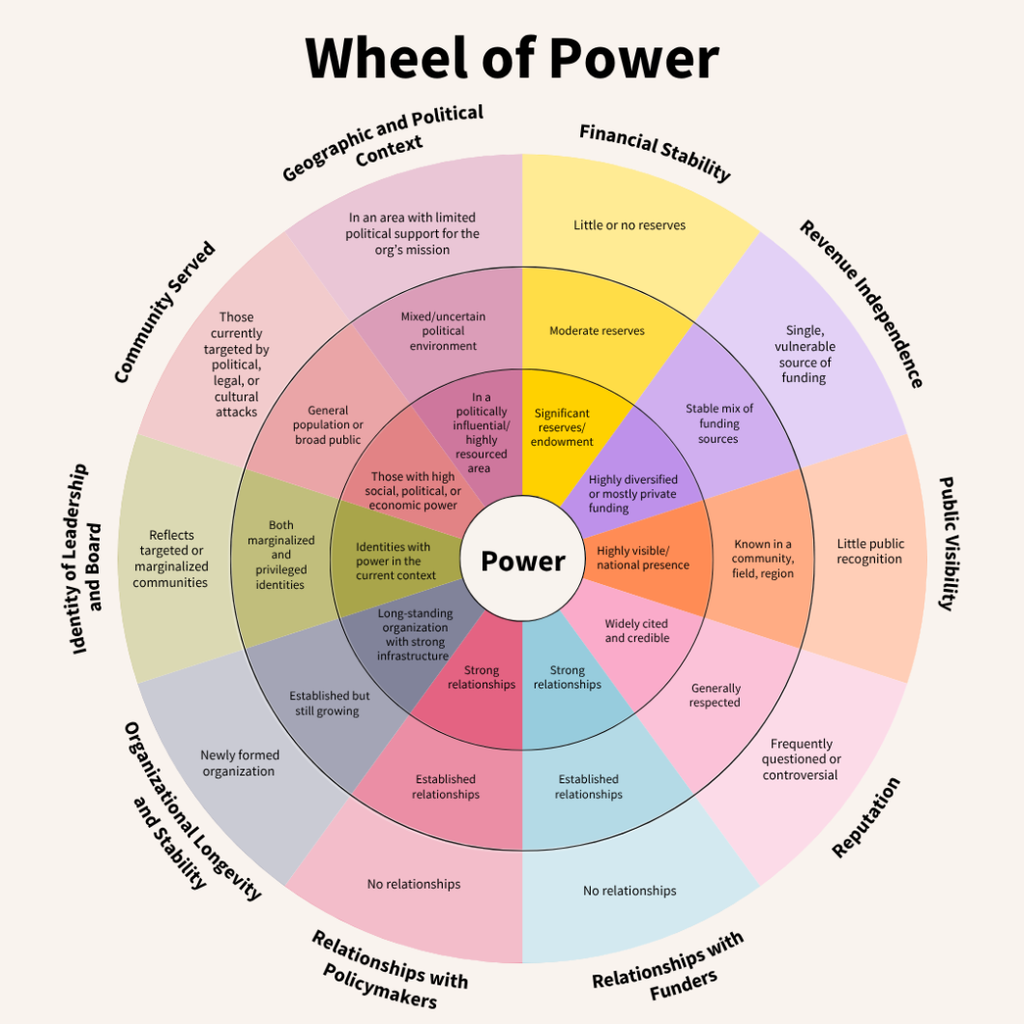
MCN suggests using this wheel as a way to frame conversations with nonprofit staff and boards. You can find discussion questions, as well as more context surrounding the Wheel of Power, here:
The Organizational Wheel of Power: A New Resource for Reflection and Action
An MCN Event
January 11, 2027, 1:00 pm – 2:00 pm
Join MCN for an interactive introduction to the Organizational Wheel of Power. Together, we’ll explore how factors such as an organization’s resources, relationships, and position in society can shape its opportunities, risks, and responsibilities.